


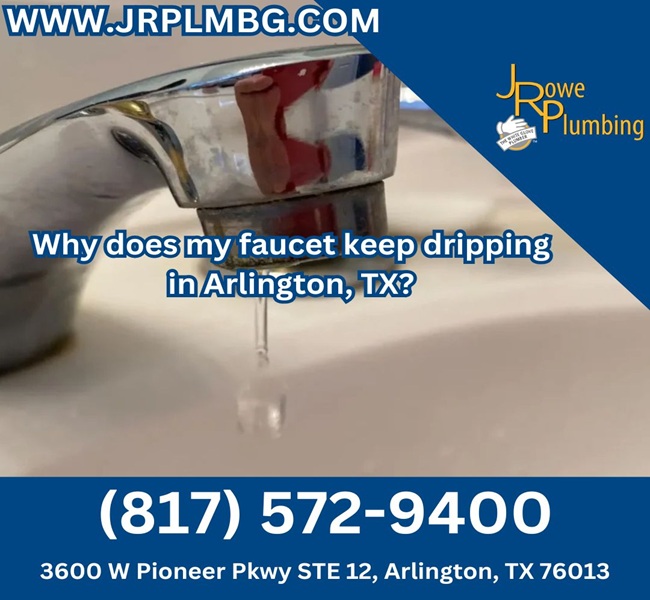
A dripping faucet in Arlington, TX is almost always caused by worn internal components, hard water mineral buildup, or damage to the valve seat inside the fixture. That slow, steady drip may feel like a minor inconvenience, but it signals a mechanical failure that will not correct itself over time. For homeowners and landlords across Arlington, identifying the root cause of a dripping faucet is the first step toward stopping water waste, preventing hidden moisture damage, and making a smart decision about whether to repair or replace. Arlington's municipal water supply carries a mineral hardness level between 250 and 350 parts per million, a concentration that accelerates internal faucet wear faster than the national average. Whether the fixture is a ball-type faucet in the kitchen or a ceramic disc unit in a bathroom, the drip has a specific cause, and a qualified plumber can identify that cause and determine the right fix.
What a Dripping Faucet Is Really Costing You
Water Waste That Shows Up on Your Utility Bill
A single faucet dripping at just one drop per second wastes more than 3,000 gallons of water over the course of a year. For Arlington homeowners already managing hard water treatment costs and seasonal utility adjustments, that added consumption registers on every billing cycle without delivering any benefit. The problem compounds across older homes where two or three fixtures may be dripping at different rates simultaneously.
What makes this particularly costly is the range where most drips land. A drip that is slow enough to ignore but fast enough to register on the meter sits in a zone where homeowners often delay action. That delay is where the real volume of waste accumulates, quietly, month after month.
The Water Damage You Cannot See Yet
The water coming out of a dripping spout goes down the drain, but the moisture that collects around the fixture base, inside the cabinet beneath the sink, and along the back wall of the vanity does not evaporate quickly in a closed space. Over time, that persistent moisture stains porcelain, deteriorates grout, and works its way into cabinet materials that were never designed for prolonged water exposure.
This is especially relevant in Arlington's pre-1990 housing stock. Many homes built before that decade used particleboard or lower-grade plywood in under-sink cabinet construction. Those materials absorb moisture readily. A faucet that drips unchecked for several months can turn what should have been a straightforward fixture repair into a project that involves cabinet replacement and mold remediation. Early Water Leak Repair keeps the problem a plumbing issue rather than a structural one.
Common Causes of a Dripping Faucet in Arlington
Worn Washers, O-Rings, and Cartridges
The most frequent cause of a dripping faucet is internal component wear. Every time a faucet is turned on or off, the washer inside the handle assembly presses against the valve seat to form a seal. That repeated contact creates friction, and over time the washer degrades until it can no longer seat tightly enough to stop water flow when the handle is in the closed position.
O-rings serve a similar sealing function but are positioned at different points within the faucet body, typically around the stem or spout base. When O-rings deteriorate, water escapes from the base of the spout rather than the tip, which is a different symptom that points to a different failure point. Cartridge faucets replace the washer and stem assembly with a single unit. When the cartridge wears out, the dripping begins at the spout even when the handle is fully closed, because the cartridge can no longer maintain pressure at the shutoff point.
Hard Water Mineral Buildup
Arlington's water hardness level, which consistently falls between 250 and 350 parts per million, is classified as very hard by EPA standards. The calcium and magnesium in that water deposit on every internal surface they contact over time, including the valve seat, the ceramic disc surface, the cartridge housing, and the washer contact points.
Mineral scale does not simply restrict water flow. It creates a textured, uneven surface inside the valve that prevents components from closing flush. A washer or disc that cannot seat cleanly against a scaled surface will allow water to bypass it even when the handle is in the fully closed position. This is one of the most common and most overlooked reasons Arlington faucets develop a persistent drip without any obvious single failed component. The failure is distributed across the surface of the valve itself, making professional Leak Detection a valuable step before assuming any single part is to blame.
A Damaged Valve Seat or Ceramic Disc
The valve seat is the junction point between the faucet body and the spout, and it is where the washer presses to stop water flow. Sediment and mineral deposits accumulate around the valve seat over years of use, corroding and pitting the surface until it becomes too irregular for a washer to seal against. Once pitting sets in, replacing the washer alone will not resolve the drip because the contact surface itself is compromised.
Ceramic disc faucets use two precision-ground discs that rotate against each other to control both temperature and flow. When hard water deposits scratch or crack those discs, the faucet drips even when the handle feels firm and fully seated. Because ceramic disc faucets are typically found in higher-quality fixtures, homeowners sometimes assume the problem is more serious than it is. In most cases, the issue is a degraded disc that needs replacement, not a full fixture replacement.
Why Faucet Type Changes the Diagnosis
Ball and Cartridge Faucets
Ball faucets are common in kitchen sink installations across Arlington's older homes. They use a rotating ball mechanism paired with rubber seats and springs to control both water temperature and flow rate through a single handle. When any component inside the ball assembly wears out, the faucet typically drips from the spout or develops a leak at the base of the handle. Because the assembly contains multiple small parts working together, identifying the exact failed component requires careful disassembly and inspection.
Cartridge faucets appear in both single and double-handle configurations and are found in kitchens and bathrooms throughout the area. The cartridge functions as a unified unit controlling water flow through the faucet. When it fails, the repair path is generally more direct because the cartridge is replaced as a whole rather than requiring individual washer or spring assessment. Matching the replacement cartridge to the original manufacturer specifications is important for a proper seal.
Ceramic Disc and Compression Faucets
Ceramic disc faucets are identifiable by their single-lever handle positioned over a wide cylindrical body. The internal ceramic discs rotate in opposite directions against each other to regulate flow and temperature. These fixtures are engineered for longevity, but Arlington's hard water mineral content gradually wears the disc surfaces and can produce a steady drip even in fixtures that are only a few years old. A thorough cleaning of mineral deposits combined with disc replacement typically resolves the problem without requiring a full fixture change.
Compression faucets are among the oldest designs still actively found in pre-1990 Arlington homes. They operate by physically compressing a rubber washer against the valve seat each time the handle is closed. Because of the direct mechanical contact involved in every shutoff, the washer wears faster than in any other faucet design. If you have a two-handle faucet that requires increasingly firm effort to shut off completely, and the drip resumes shortly after closing, a worn compression washer is the most likely cause.
What Your Drip Is Telling You
| Symptom | Likely Cause |
|---|---|
| Dripping from the spout with the handle fully closed | Worn cartridge, washer, or ceramic disc no longer forming a complete seal |
| Water leaking from the base of the spout | Deteriorated O-ring on the stem or spout base allowing water to bypass the seal |
| Drip worsens gradually and the handle requires more force to close | Mineral scale buildup on the valve seat preventing components from seating flush |
| Water seeping from the handle area rather than the spout | Failed packing nut or cracked cartridge housing allowing water to escape the stem |
| Dripping occurs only when hot water is used | Worn hot side washer or failing cartridge on the hot water supply side specifically |
Repair or Replace: How to Know the Difference
Not every dripping faucet requires a full replacement. The decision between repair and replacement depends on the age of the fixture, the scope of internal wear, and whether mineral scaling has damaged components that a part swap alone cannot restore.
A faucet that is fewer than ten years old and dripping because of a single worn washer, O-ring, or cartridge is typically a strong candidate for Leaky Faucet Repair. The structural components of the faucet body are likely still sound, and a targeted repair will restore normal function without requiring a complete fixture change.
Fixtures that are fifteen or more years old, showing visible external corrosion, or experiencing failures across multiple internal components at the same time are generally better candidates for replacement. In Arlington's hard water environment, older faucet bodies accumulate years of internal scale that can accelerate wear on any new parts installed. Replacing the fixture at that stage provides a longer-lasting result and eliminates the cycle of recurring repairs that comes with repeatedly servicing a heavily scaled valve assembly.
A licensed plumber can evaluate not only the faucet itself but also the condition of the supply valves and stop valves behind the fixture, which in older homes are sometimes in worse shape than the faucet being repaired. Addressing both together avoids a second service call down the line.
Arlington Homeowners and Landlords Trust J. Rowe Plumbing
J. Rowe Plumbing has been serving homeowners and landlords across Arlington since 1984. That four-decade history of residential and commercial plumbing service reflects a consistent track record of working through the specific challenges older Arlington homes present, including hard water fixture wear, aging pipe materials, and faucet repairs across every type and manufacturer.
The team holds a Responsible Master Plumber license and carries Viega ProPress and Gastite certifications, bringing documented technical qualifications to every service call. J. Rowe Plumbing has earned a BBB A+ rating maintained over 30 years of operation, multiple Nextdoor Neighborhood Favorites recognitions, and the Angie's List Super Service Award, a body of recognition that reflects the trust Arlington residents and property managers have placed in the company over time.
For landlords managing rental properties with multiple fixtures across older units, the same level of diagnostic care applies to every service call. Same-day service is available during business hours, so a dripping faucet does not have to become a tenant complaint that lingers for days.
Wrapping Up
A faucet that keeps dripping in Arlington is rarely a random occurrence. It is the result of specific internal wear accelerated by the area's very hard water supply, the age of the fixture, and the mechanical stress of daily use. Worn washers, degraded O-rings, scaled valve seats, and failing cartridges are all identifiable causes with direct repair paths when caught early enough.
Homeowners and landlords who address the drip promptly keep the work straightforward. Those who delay often find that accumulated moisture damage, corroded supply valves, and extensive mineral scaling have turned a simple repair into a larger project. The original question, why does my faucet keep dripping, always has a specific answer. Finding that answer early is what keeps the solution simple.
If a faucet in your Arlington home is dripping and you want a clear diagnosis from a licensed plumber with decades of experience in this area, J. Rowe Plumbing is ready to help. Visit jrplmbg.com to learn more about our Plumbing Services or to schedule a service call during business hours.


