


When more than one drain in your home backs up at the same time, the cause is almost always a blockage in your main sewer line, not a problem isolated to a single fixture. This distinction matters because a main line blockage affects every drain that connects to it, which means your kitchen sink, bathroom sink, shower, and toilets can all show symptoms at once. For Arlington homeowners in particular, the city's expansive clay soil, aging pipe infrastructure, and hard water supply create conditions that accelerate the kind of buildup that leads to exactly this scenario. Understanding what is happening inside your pipes is the first step toward protecting your home from more serious and costly damage. A licensed plumber can assess the full scope of the problem and identify the right solution before it escalates.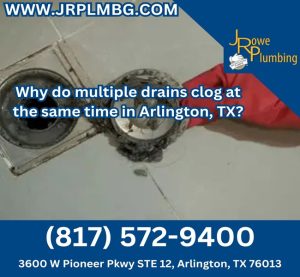
When More Than One Drain Backs Up, Your Home Is Sending a Clear Warning
What "Multiple Drains Clogging" Actually Means
A single slow drain is usually a localized problem, soap scum or hair caught in a P-trap or branch line. But when two or more drains in different rooms begin backing up around the same time, or when flushing a toilet causes water to bubble up in a nearby shower, the blockage is almost certainly located in a shared drain line or the main sewer line itself. Think of your plumbing system like a network of roads. Local roads feed onto larger collector roads, which all eventually merge onto the highway. If the highway is blocked, traffic backs up on every road connected to it.
How to Tell If It Is One Drain or a Whole-House Problem
The Quick Self-Check: Which Drains Are Affected?
Walk through your home and test each drain. Flush a toilet and watch whether water backs up into a shower or bathtub. Run your washing machine and observe whether water rises in a floor drain nearby. If you are seeing reactions across multiple fixtures, especially fixtures on different sides of the home or on different floors, the problem is not isolated. A plumber needs to assess the main line.
Diagnostic Warning Signs
| Symptom | What It Indicates |
|---|---|
| Flushing a toilet causes water to gurgle or rise in a nearby shower or tub | Main sewer line restriction or blockage; water has nowhere to go and seeks the nearest low point |
| Multiple sinks draining slowly on the same day | Shared branch line buildup or early-stage main line obstruction |
| Sewage odor coming from floor drains or toilets | Gases from a blocked or damaged sewer line are being pushed back through water seals |
| Washing machine backup flooding a utility room or neighboring drain | Main line or shared branch line is at or near full capacity |
| Toilets that barely flush or require multiple attempts | Partial main line blockage reducing flow velocity throughout the system |
The Most Common Reason Multiple Drains Fail at Once in Arlington Homes
A Blockage in Your Main Sewer Line Affects Every Drain Downstream
Your main sewer line is the single pipe that carries all wastewater from your home to the municipal sewer system. It typically runs from beneath your foundation out through the yard to the street. When this line becomes obstructed, whether from buildup, a collapsed section, or root intrusion, every drain in the house that sits upstream of that blockage will begin to back up. The symptoms usually start subtle and worsen progressively. By the time multiple fixtures are backing up simultaneously, the blockage has usually been building for months or longer.
Why This Problem Surfaces in Arlington More Than Other Cities
Arlington is not a typical plumbing environment. A combination of local soil conditions, water chemistry, and housing age creates a set of challenges that plumbers working in other parts of the country simply do not encounter at the same frequency. These factors do not operate in isolation; they compound one another over time.
Arlington's Expansive Clay Soil and What It Does to Sewer Lines
The soil across much of Arlington and the broader DFW area is composed heavily of expansive clay. This soil shrinks and swells significantly depending on moisture content. During dry Texas summers, clay soil contracts and pulls away from buried pipes. During heavy rainfall, it expands and pushes back inward. Over years and decades, this constant movement stresses sewer line joints, causing them to separate, crack, or shift out of alignment. Misaligned joints create ledges inside the pipe where debris catches and builds up. Separated joints allow surrounding soil to intrude, gradually narrowing the flow channel. This is a condition that affects homes of all ages in Arlington, but it is especially pronounced in neighborhoods built before 1990 when clay tile or cast iron pipe was commonly used.
How Hard Water Buildup (250 to 350 PPM) Accelerates Drain Restrictions
Arlington's municipal water supply measures between 250 and 350 parts per million of dissolved minerals, primarily calcium and magnesium. Water at this hardness level leaves mineral deposits on every surface it contacts, including the interior walls of your drain pipes. Over time, these mineral deposits narrow the pipe's inner diameter. This is called scale buildup, and it works similarly to cholesterol plaque in arteries. What was once a four-inch pipe may effectively function like a three-inch or even two-inch pipe after years of scale accumulation. A narrowed pipe drains slowly under normal conditions and backs up much more easily when any additional material enters the line.
Older Pipe Materials Common in Arlington's Established Neighborhoods
Many Arlington homes built between the 1950s and 1980s were originally plumbed with cast iron, Orangeburg, or clay tile drain lines. These materials have a finite service life. Cast iron corrodes from the inside out, developing rough interior surfaces that catch debris. Orangeburg, a composite material made from wood pulp and pitch, deteriorates when exposed to water over time and can collapse inward. Clay tile, while durable in stable soil, is highly vulnerable to the root intrusion and joint separation caused by Arlington's expansive clay. Homes in these age ranges are far more likely to experience simultaneous drain failures because the pipe itself has become the obstacle.
Other Causes That Can Trigger Multiple Drain Clogs Simultaneously
Shared Drain Line Blockages Between Fixtures on the Same Wall or Floor
Not every multi-drain backup originates at the main sewer line. In some cases, a blockage forms in a shared branch line, which is the secondary pipe that connects several fixtures before they tie into the main line. For example, a master bathroom toilet, sink, and shower may all share a single branch line running through a common wall. A blockage in that branch affects only those fixtures but can still mimic a whole-house problem. A plumber can isolate which drains are affected and trace the obstruction back to its origin point.
Tree Root Intrusion Into Lateral Sewer Lines
Trees are drawn toward moisture, and a buried sewer line is one of the most consistent moisture sources in a yard. Roots from oak, elm, and hackberry trees, all common in Arlington landscapes, seek out the smallest gaps in pipe joints and grow inward. Once inside, roots spread into a network that can eventually fill the pipe entirely. Root intrusion is one of the leading causes of recurring sewer line blockages in Arlington neighborhoods with mature tree canopies. It is also one of the conditions that a basic drain snake cannot permanently resolve because the roots grow back unless the pipe is treated or replaced. Professional Drain Cleaning with the right equipment is what removes the obstruction fully and helps restore proper flow throughout the system.
Grease, Soap Scum, and "Flushable" Wipes Compounding Over Time
Daily household habits contribute to sewer line blockages more than most homeowners realize. Grease poured down a kitchen drain cools and congeals further down the pipe. Soap scum from showers and bathtubs adheres to pipe walls and traps hair and debris. And despite the label, products marketed as "flushable" wipes do not break down the way toilet paper does. They travel down the drain intact and can catch on any irregularity inside a pipe, forming a net that traps everything else passing by. In a pipe already narrowed by mineral scale or offset by soil movement, these materials accumulate much faster than they would in a new, undamaged line.
What You Should Never Put Down an Arlington Drain
- Cooking grease, oil, or butter in any form
- Flushable wipes, paper towels, or anything other than toilet paper
- Coffee grounds, which bind together and form dense plugs
- Food scraps beyond what a functional garbage disposal can fully liquefy
- Chemical drain cleaners used repeatedly, which can corrode older pipe materials from the inside
What Happens If You Ignore Multiple Drain Clogs in Your Home
Sewage Backup Risk and When It Becomes a Health Hazard
A sewer line that is partially obstructed will eventually become fully obstructed. When that happens, wastewater has nowhere to go except backward. Sewage can back up through floor drains, toilets, and showers, contaminating flooring, drywall, and subflooring with bacteria and pathogens. Sewage backup is classified as a Category 3 water intrusion, meaning it carries the highest level of biological contamination. Remediation costs, structural drying, and replacement of affected materials can turn an ignored drain problem into an extensive renovation project.
Structural Damage From Long-Term Sewer Line Stress
A sewer line that has been shifting, cracking, or leaking beneath a home's foundation for an extended period does not just affect plumbing. Wastewater escaping from a compromised line saturates the surrounding soil. In Arlington's clay-heavy ground, saturated soil expands with greater force, placing additional stress on the foundation. Homeowners who delay Sewer Line Repair sometimes discover later that foundation movement and settling occurred in part because of an undetected plumbing issue beneath the slab.
How a Small Blockage Becomes a Full Sewer Line Replacement
The progression is predictable. A joint separates slightly due to soil movement. Roots or debris enter at that joint. Scale buildup narrows the pipe around the obstruction. Homeowners clear the visible symptom with a drain snake, but the underlying structural problem remains. The cycle repeats, the damage worsens, and eventually the pipe has deteriorated to the point where clearing it is no longer sufficient. A problem that could have been addressed with a jetting service or a localized repair becomes a full sewer line replacement. Early detection through a professional inspection is what prevents that outcome.
What a Professional Plumber Checks When Multiple Drains Are Clogged
Sewer Line Camera Inspection: What It Reveals
A sewer camera inspection inserts a waterproof, flexible camera through a cleanout access point and runs it the length of the sewer line. The camera transmits live footage showing the interior condition of the pipe in real time. A plumber can see buildup, cracks, root intrusion, offset joints, collapsed sections, and any foreign material lodged in the line. This removes all guesswork and allows for a targeted repair plan rather than exploratory digging.
Smoke Testing to Identify Hidden Break Points
Smoke testing introduces non-toxic smoke into the sewer system under pressure. Any crack, open joint, or break in the line allows smoke to escape, marking the precise location of the defect above ground. This technique is particularly valuable in Arlington because soil movement often shifts pipe joints in ways that are difficult to detect without pressurized testing. Pairing smoke testing with professional Leak Detection gives plumbers a complete picture of where the sewer system is compromised, including breaks that may not yet be causing active backups but are undermining the system's long-term integrity.
How a Whole House Plumbing Inspection Catches Problems Before They Escalate
A whole house plumbing inspection evaluates every component of a home's plumbing system, from supply lines and water heater performance to drain lines, sewer connections, and fixture conditions. For Arlington homeowners dealing with multiple drain issues, a comprehensive inspection provides context that a single service call cannot. It identifies whether the drain problem is isolated or part of a broader pattern of aging infrastructure, and it produces a clear picture of what is working, what needs attention soon, and what is a near-term priority.
What J. Rowe Plumbing's Inspection Covers for Arlington Homeowners
J. Rowe Plumbing has been serving Arlington homeowners since 1984. When a whole house plumbing inspection is performed, the technician evaluates drain line condition and flow, checks for signs of root intrusion or pipe offset in the sewer lateral, assesses water heater performance and safety components, inspects exposed supply lines and shut-off valves, tests fixture function, and reviews any plumbing concerns the homeowner has observed. The goal is not to generate a list of upsells but to give the homeowner an accurate, honest picture of their home's plumbing health so they can make informed decisions.
When Should You Call a Plumber for Multiple Clogged Drains?
Signs the Problem Is Beyond DIY
If only a single drain is slow and there are no other symptoms, a basic cleaning may be appropriate as a first step. However, any of the following signs indicate it is time to call a licensed plumber rather than attempt further troubleshooting on your own.
- Two or more drains are backing up at the same time
- Flushing a toilet causes water to move in a drain or fixture elsewhere in the home
- A sewage odor is present inside the home
- Drains that were cleared recently are backing up again within weeks
- Water is pooling near a foundation cleanout or in a basement or crawl space
Why Fast Response Matters With Main Line Issues
A main line blockage under pressure does not stabilize on its own. Every flush and every drain cycle pushes more material against the obstruction and increases pressure on the compromised section of pipe. Acting quickly limits the damage, reduces the likelihood of a sewage backup inside the home, and preserves more of the existing pipe. Waiting extends all of those risks and often converts a repair into a replacement.
J. Rowe Plumbing: 40 Years Serving Arlington Homeowners
Founded in 1984 by James Rowe, J. Rowe Plumbing has spent four decades learning the specific plumbing challenges that Arlington's soil, water, and housing stock present. The company holds a Responsible Master Plumbing License, maintains BBB accreditation, and has been recognized as a Nextdoor Neighborhood Favorite and Best of Arlington recipient. Technicians respond to service requests within minutes and arrive in fully stocked trucks ready to diagnose and address the problem during the first visit. That kind of local experience and commitment to getting the job done right is exactly what a whole-house plumbing issue in an Arlington home requires.
Conclusion
When multiple drains in your Arlington home back up at the same time, the answer is almost never a coincidence. It is a signal that something is wrong further down the line, and in a city built on expansive clay soil with older pipe infrastructure and hard water running through every fixture, that signal deserves prompt attention. The combination of environmental factors that make Arlington unique also make its sewer lines more vulnerable to the kind of progressive damage that starts as a slow drain and ends as a sewage backup or a sewer line replacement.
Catching the problem early through a whole house plumbing inspection protects your home, your foundation, and your budget. J. Rowe Plumbing has been diagnosing and solving exactly these kinds of problems for Arlington homeowners for over 40 years. If your drains are telling you something is wrong, trust the team that knows this city's plumbing inside and out. Explore our full Plumbing Services or learn more about what J. Rowe Plumbing can do for your home at jrplmbg.com.


