


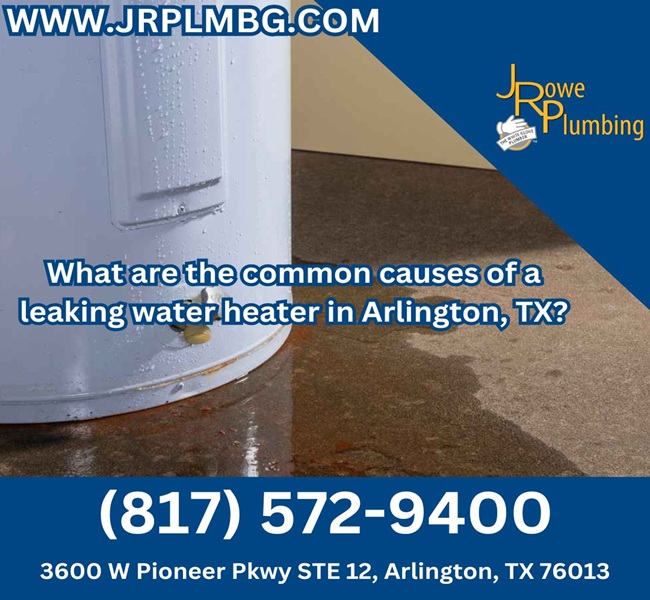
The most common causes of a leaking water heater are sediment buildup, a failing anode rod, a faulty temperature and pressure relief valve, corroded connections, a cracked or corroded tank, and a worn drain valve. Each of these issues develops gradually, and the location of the leak on the unit is often the clearest clue to what has gone wrong. For homeowners in Arlington, TX, where the water supply carries a significant mineral content and older housing stock is common, these problems tend to show up earlier and more frequently than national averages suggest. Understanding what is behind the leak helps you make a faster, more confident decision about whether a plumber can resolve it with a targeted repair or whether full replacement is the right path forward.
A Leaking Water Heater Is a Warning, Not Just a Nuisance
A few drops of water near the base of a tank are easy to dismiss. Many homeowners wipe it up and assume a pipe nearby is sweating or that condensation settled on the floor. That instinct, while understandable, can be costly. A water heater does not develop a leak and then stabilize on its own. The underlying cause almost always worsens over time, and the water that escapes along the way does damage to flooring, subfloor material, adjacent walls, and sometimes to the structure of the home itself. Addressing leaks promptly not only protects your property from costly damage but can also help improve your home's water quality by preventing corrosion, sediment buildup, and other issues that may affect your plumbing system.
What Is Actually at Risk When a Leak Goes Unaddressed
Beyond the immediate water damage, a neglected leak creates conditions for mold growth within 24 to 48 hours in the right temperature environment. In a utility closet or garage setting, that growth can go undetected for weeks. There is also the risk of a catastrophic tank failure, which releases a large volume of water in a short period. For homes with water heaters located above finished living spaces or in elevated utility rooms, that scenario carries real structural and financial consequences. Treating a leak as a warning rather than an inconvenience is the first sound step any homeowner can take.
Start With Location: Where Is the Leak Coming From?
Before diagnosing the cause, narrow down where the water is originating. Wipe the area dry and watch it carefully for several minutes. Use a paper towel or tissue to detect moisture that is not yet visible to the eye, or schedule professional Leak Detection if the source is not immediately clear. The position of the leak on the unit tells a specific story.
Leaks at the Top of the Tank
Water pooling at the top of the unit typically points to the cold water inlet or hot water outlet connections. These pipe fittings can loosen over years of thermal expansion and contraction. The inlet nipple, which is the fitting that threads into the tank itself, is also a common failure point, particularly in older units where the nipple material has corroded. In many cases, Water Heater Repair is possible here without replacing the full unit.
Leaks Near the Middle or Side of the Tank
Moisture appearing on the side of the tank usually traces back to the temperature and pressure relief valve, commonly called the T and P valve. This component is mounted partway up the tank and has a discharge pipe that runs downward. When the valve weeps or actively drips, it is either responding to high pressure conditions inside the tank or the valve itself has worn out. In either case, the condition requires prompt attention.
Leaks at the Bottom of the Tank
A leak at the base of the unit is the one that warrants the most concern. It can indicate a failing drain valve, which is often repairable, but it can also indicate internal corrosion that has compromised the tank wall. Once the interior lining of a tank is breached by corrosion, the tank cannot be restored. Replacement becomes the only practical path at that point.
The Most Common Causes of Tank Water Heater Leaks
Sediment Buildup Inside the Tank
Over time, minerals present in the water supply settle at the bottom of the tank. In Arlington, where water hardness regularly falls in the 250 to 350 parts per million range, this accumulation happens more aggressively than in areas with softer water. As sediment builds up, it insulates the bottom of the tank from the burner below, forcing the unit to run hotter and longer to heat the water above it. That sustained heat stresses the tank lining, eventually creating small fractures or pinhole leaks. A rumbling or popping sound during heating cycles is often the first signal that sediment has reached a problematic level.
A Failing or Depleted Anode Rod
Inside every tank water heater is a sacrificial anode rod, typically made of magnesium or aluminum. Its purpose is to corrode in place of the steel tank walls, protecting the interior of the unit from rust. When the anode rod is fully depleted and not replaced, the tank itself becomes the material that oxidizes. Corrosion then spreads across the interior lining and eventually reaches the outer wall. Most manufacturers recommend inspecting the anode rod every two to four years. In high mineral environments, that inspection interval should lean toward the shorter end.
Temperature and Pressure Relief Valve Discharge
The T and P valve is a safety component. When the pressure or temperature inside the tank rises beyond safe operating limits, the valve opens to release that pressure. If you notice water dripping from the discharge pipe that runs from this valve, there are two possibilities. Either the pressure inside the tank is chronically elevated, which can result from a missing or undersized expansion tank on the system, or the valve itself has worn to the point where it no longer seals properly when closed. Both conditions require a licensed plumber to evaluate.
Loose or Degraded Inlet and Outlet Connections
The connections where the cold supply enters and where hot water exits the unit are threaded fittings subject to years of movement. Every heating cycle causes the tank to expand slightly and contract again as it cools. Over a decade or more, that repeated movement works fittings loose and deteriorates thread sealant. Dielectric nipples, which prevent galvanic corrosion between dissimilar metals at these connections, also degrade over time and can become leak points themselves.
A Corroded or Cracked Tank
Internal tank corrosion is the most serious cause on this list because it has no repair solution. Once the steel interior of the tank has corroded through to the outer shell, the unit is at end of life. Rust colored water coming from hot taps, a metallic taste in the hot water supply, or visible rust streaking on the exterior of the tank are all indicators that internal corrosion is already underway. At this stage, continuing to run the unit is a calculated risk that most experienced plumbers would not recommend.
A Faulty or Worn Drain Valve
The drain valve is a threaded fitting near the base of the tank used for flushing sediment during maintenance. Over years of use, or simply from age and mineral exposure, the valve seat can degrade and allow a slow drip. In some cases, the fix is as simple as tightening the valve handle or replacing the valve itself. In others, especially when the valve has not been operated in many years, the corrosion around the fitting makes a clean repair difficult without a full tank replacement.
| Symptom | Likely Cause |
|---|---|
| Rust colored or discolored hot water | Internal tank corrosion or a depleted anode rod |
| Water pooling at the base of the tank | Corroded tank lining, leaking drain valve, or sediment damage |
| Dripping from the side mounted discharge pipe | T and P valve failure or elevated system pressure |
| Rumbling or popping sounds during heating cycles | Heavy sediment accumulation at the tank floor |
| Moisture or corrosion at the top of the unit | Loose or degraded inlet and outlet pipe connections |
Repair or Replace? What the Leak Location Tells You
Leaks That Are Typically Repairable
Not every leak means the unit is done. Several common leak sources can be corrected without replacing the tank:
- Loose or corroded inlet and outlet connections can be re-fitted or replaced
- A worn T and P valve can be swapped out for a new one
- A leaking drain valve can often be replaced as a standalone component
- An expansion tank can be added to address chronic pressure issues
- A depleted anode rod can be replaced if the tank interior is still sound
The key factor in all of these scenarios is the overall condition of the tank itself. If the unit is under ten years old and there are no signs of internal corrosion, a targeted repair is a reasonable and cost effective approach.
Leaks That Point Toward Full Replacement
Certain findings shift the decision firmly toward replacement. If the tank is at or beyond its expected service life, which is typically eight to twelve years for a standard residential unit, the economics of repair rarely favor keeping it. If rust colored water is coming from the hot side, if there is visible exterior rust, or if the leak is originating from a breach in the tank wall itself, there is no repair that addresses the root condition. In Arlington homes built before 1990, it is common to encounter water heaters that are well past the point where a repair would be a wise investment. A licensed plumber can assess the unit and determine whether Water Heater Replacement is the most practical path forward.
What Arlington Homeowners Should Do Next
If you have identified a leak or strong signs of one, there are a few immediate steps worth taking while you arrange for a plumber to evaluate the unit.
- Turn off the cold water supply valve above or near the top of the unit to limit further water introduction
- Switch the unit to vacation mode or pilot mode rather than shutting off gas or power completely, unless the leak is severe
- Place towels or a shallow pan to protect flooring while you wait
- Note the location of the leak, whether it is at the top, side, or bottom, and any sounds or water color changes you have observed
- Check the unit label for the model and serial number, which a plumber will use to determine the age of the unit
These steps keep the situation from worsening and give your plumber the information needed to assess the problem efficiently from the moment they arrive.
The Takeaway for Homeowners Dealing With a Leaking Water Heater
A leaking tank water heater is almost never a single isolated event. It is the result of a process that has been developing inside the unit for months or years, and the location and nature of the leak is your clearest guide to what that process has produced. Sediment buildup, anode rod depletion, T and P valve wear, degraded connections, and internal corrosion each carry their own repair or replacement logic, and none of them resolve themselves over time.
For Arlington homeowners, the combination of hard water, aging housing stock, and the temperature swings the region sees through the year means water heater wear tends to be accelerated. Acting on a leak early, before it advances to tank failure, is consistently the better outcome both for the home and for the household budget.
J. Rowe Plumbing has been serving Arlington and the surrounding Tarrant County area since 1984. If your water heater is showing signs of a leak, our licensed plumbers can assess the unit, explain your options clearly, and handle Water Leak Repair or full replacement the right way. Visit us at jrplmbg.com to learn more about our water heater services or to schedule an appointment.


